Feverish Bodies, Enlightened Minds by Thomas Apel
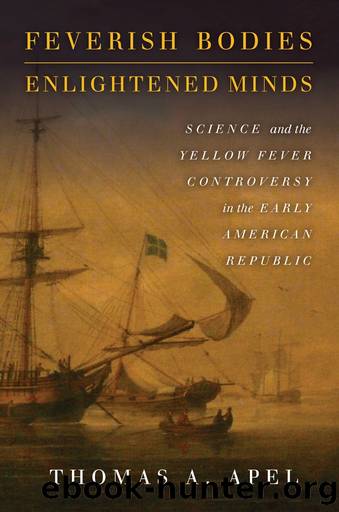
Author:Thomas Apel [Apel, Thomas]
Language: eng
Format: epub
Tags: Science, General, History, United States, Revolutionary Period (1775-1800), Medical
ISBN: 9780804797405
Google: IMPTwAEACAAJ
Publisher: Stanford University Press
Published: 2016-03-30T22:24:19+00:00
FIVE
âIn Politics As Well As Medicineâ; or, The Arrogance of the Enlightened
Nor grieve that slander, with malicious rage,
Fierce war against thy glory wage:
Beneath a grim, ferocious sway,
Palmyraâs ruins gloomâd the desert way;
But wide oâer earth their fame forever flies;
Amid their venerable shade,
Oft hath the musing pilgrim strayâd
There, oft, the Genius of the waste,
Wanders, & thinks upon the past;
Counts oâer the mouldering piles, & sighs
Nor yet, thoâ factionsâ busy imps defame,
And load with every word of shame,
Think that the offspring of thy mind,
Was eâer for mischiefâs evil designed1
ELIHU HUBBARD SMITH, 1795
When Benjamin Rush resigned from the College of Physicians of Philadelphia in 1793, an institution he helped form only a few years before, he cited the âpersecutionsâ he suffered from the fellows of the college as justification. âBesides combating with the yellow fever,â he fulminated to his wife, Julia Rush, on September 13, âI have been obliged to contend with the prejudices, fears, and falsehoods of several of my brethren, all of which retard the progress of truth and daily cost our city many lives.â2 Days later, again to Julia, âThey have confederated against me in the most cruel manner and are propagating calumnies against me in every part of the city.â He continued, âIf I outlive the present calamity, I know not when I shall be safe from their persecutions. Never did I before witness such a mass of ignorance and wickedness as our profession has exhibited in the course of the present calamity. I almost wish to renounce the name of physician.â3 The âcalumniesâ directed against Rush focused principally on his âheroicâ treatmentâthe bloodlettings and purges that left his patients dazed and depleted.4 By November 5, when Rush tendered his letter of resignation to John Morgan, the president of the College of Physicians, the epidemic had all but ended; he might have expected the abuses from his colleagues to have ended too.
Yet, to Rushâs chagrin, the persecutions continued. As he saw it, the contagionists had conspired together and were attempting to commandeer the yellow fever discourse not only by disparaging their opponents but by disseminating falsehoods that deceived the people. By 1797, the contagionist âfaction,â as he liked to call it, had grown so bold in its intrusionsâand so successful in having its quarantine restrictions enactedâthat Rush and his localist friends founded the Academy of Medicine of Philadelphia, an institution meant to rival the contagionist-controlled College of Physicians. The Academy of Medicine would liberate both physicians and the public from the tyranny of the contagionists, thereby rescuing unprejudiced medical inquiry. Rush wrote to Noah Webster, explaining the meaning and importance of the Academy: âAll those physicians who believe in the domestic origin of yellow fever . . . have lately formed themselves into a medical society for the purpose of promoting medical science untrammeled by the systems of medicine which now govern the greatest part of the Physicians in our city.â5 For the rest of the epidemic period, both the College and the Academy published opposite explanations for the cause of yellow fever.
Download
This site does not store any files on its server. We only index and link to content provided by other sites. Please contact the content providers to delete copyright contents if any and email us, we'll remove relevant links or contents immediately.
| Administration & Medicine Economics | Allied Health Professions |
| Basic Sciences | Dentistry |
| History | Medical Informatics |
| Medicine | Nursing |
| Pharmacology | Psychology |
| Research | Veterinary Medicine |
Periodization Training for Sports by Tudor Bompa(8278)
Why We Sleep: Unlocking the Power of Sleep and Dreams by Matthew Walker(6729)
Paper Towns by Green John(5195)
The Immortal Life of Henrietta Lacks by Rebecca Skloot(4593)
The Sports Rules Book by Human Kinetics(4396)
Dynamic Alignment Through Imagery by Eric Franklin(4220)
ACSM's Complete Guide to Fitness & Health by ACSM(4061)
Kaplan MCAT Organic Chemistry Review: Created for MCAT 2015 (Kaplan Test Prep) by Kaplan(4015)
Introduction to Kinesiology by Shirl J. Hoffman(3776)
Livewired by David Eagleman(3776)
The Death of the Heart by Elizabeth Bowen(3626)
The River of Consciousness by Oliver Sacks(3607)
Alchemy and Alchemists by C. J. S. Thompson(3526)
Bad Pharma by Ben Goldacre(3429)
Descartes' Error by Antonio Damasio(3281)
The Emperor of All Maladies: A Biography of Cancer by Siddhartha Mukherjee(3165)
The Gene: An Intimate History by Siddhartha Mukherjee(3099)
The Fate of Rome: Climate, Disease, and the End of an Empire (The Princeton History of the Ancient World) by Kyle Harper(3067)
Kaplan MCAT Behavioral Sciences Review: Created for MCAT 2015 (Kaplan Test Prep) by Kaplan(2988)
